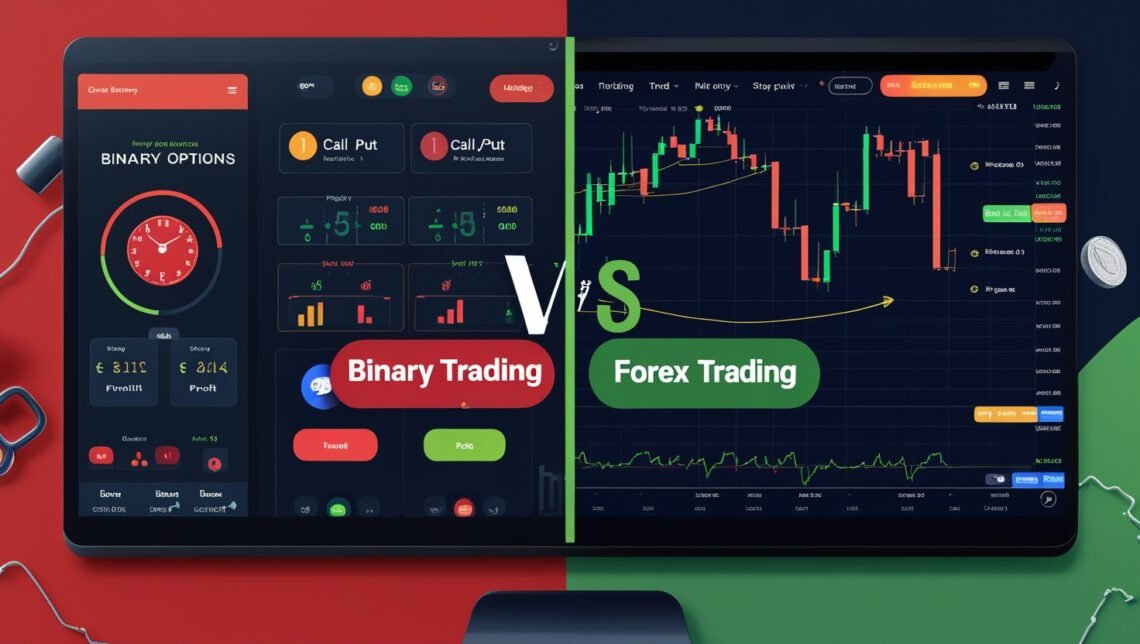
Binary trading and forex trading are both part of the financial markets, but there are many fundamental differences between them. Binary trading is a simplified and short-term investment method where you just have to predict whether the market will go up or down at a specific time. If your prediction is correct, you get a fixed payout, but if it is wrong, you lose all your money. This is also called “all or nothing” trading. Forex trading is more complex than this but offers more flexibility and control. In it, you trade in pairs of currencies like USD/EUR, and the profit or loss depends on your position and the movement of the market.
The forex market operates 24 hours a day, and there is also the concept of leverage, which means that you can take a large position even with a small investment. The purpose of this introduction is to give the reader a basic understanding of how binary trading and forex trading work, what their approach is, and what opportunities and risks they present for the investor. Both trading styles have their unique structure and the way of working, time frame, and risk tolerance are completely different. In this blog, we will understand both systems deeply so that you can choose the best trading path for yourself.
How Binary Trading Works:
The concept of binary trading is very simple, but the risk is also high. Binary means “two possibilities,” i.e., either win or lose. In this, you predict whether the price of an asset, like a currency pair, stock, or commodity, will go up or down at a specific time. If your prediction is correct, then you get a profit of a fixed amount, which is decided in advance, but if your prediction is wrong, then you lose all your invested money. This type of trading is also called short-term options because their duration is a few minutes or hours. Binary trading is mostly done on regulated platforms, but sometimes people also invest in non-regulated websites where there is a risk of scams. In binary trading, you need market knowledge, fast decision-making, and strong prediction skills.
There is no option for stop loss or take profit, and your outcome depends only on whether you have predicted the correct direction or not. There is no leverage, and risk is fixed, but reward is also capped. This trading style seems attractive to people who want quick results in the short term. But it is also important to remember that the ratio of losses is also quite high if you invest without analysis. Discipline and limited risk-taking are very important in this.
How Forex Trading Works:
Forex trading is the largest financial market in the world, where daily trillions of dollars’ worth of business takes place. In this market, you trade in pairs of currencies, such as USD/EUR, GBP/JPY, or AUD/USD. This means that you are buying one currency and selling the other. The Forex market operates 24 hours a day, 5 days a week, where you can trade according to different time zones. In this, you get leverage, which means that a large position can be opened even with a small investment. Profit or loss in forex trading depends on the difference between your entry and exit price, and tools like stop loss and take profit help you in your risk management. This trading is based on real-time analysis, charts, indicators, and market news.
You can make both short-term and long-term types of trades. Decision making in this is more flexible than binary trading. Forex trading may seem a little difficult initially for beginners, but with the right strategy and patience, it can become a powerful source of long-term earnings. It has more risk but also more control because you can adjust your position against the market. The structure of the Forex market is transparent, and the world’s central banks and financial institutions are also involved in it. Therefore, this market is strong in both credibility and liquidity.
Risk and Reward Comparison:
When we compare the risk and reward of binary trading and forex trading, there is a huge difference between the two. The biggest risk in binary trading is that you either win or lose everything. There is a fixed payout and fixed loss in it. If you invest 100 dollars and the trade goes wrong, you get zero. But if it goes right, you get a fixed return of 70 to 90 percent. This system seems to give quick rewards in the short term, but consistent profit is difficult in the long term.
In forex trading, the risk is more dynamic, but the reward is also flexible. You can control your risk through stop loss and take profit. Forex offers leverage, which gives you a chance to earn more, but if misused, it can lead to huge losses. Emotional control and discipline are very important in both trading types, but in binary, a wrong prediction can take everything away, whereas in forex, you can save something by adjusting your position. The level of risk tolerance is different for every person, and on this basis, it is decided which system is better for you. For those who like to work with short-term and fixed risk, binary is better for them, and for those who want flexible trading by going deeper into the market, forex is right for them.
Which One is Better for Beginners?
For beginners, which one is better, binary trading or forex trading, depends on their trading style, risk tolerance, and learning capacity. Binary trading may seem quite simple, as you only need to predict whether the market will go up or down. This simplicity is why many beginners choose binary, but this simplicity can be deceptive, as if the prediction goes wrong, you can lose all your money. Forex trading, on the other hand, has a steeper learning curve, but it gives you more control and tools such as stop loss, risk-reward ratio, leverage management, and market analysis. Forex trading can give beginners more benefits in the long term if they want to learn with patience.
There is more emotional pressure in binary trading because the result of every decision is seen immediately, whereas in forex, you can take time by doing analysis. The environment of forex trading is more professional, and you can also practice through demo accounts. Therefore, if a beginner is serious and wants to take the time to understand the market, then forex is a better choice. But if someone only wants thrill and fast reward, then they should stick to binary, which can be risky. Every beginner should understand that there is risk in both systems, and without proper training, no system is safe.
Conclusion:
Finally, when we complete binary and forex trading, we realize that both trading types are unique in their way. Binary trading may be good for those who want fast results, like to work with fixed risk, and feel comfortable in short-term decisions. But the risk is also high, and long-term sustainability is difficult. Forex trading is best for those who want to pursue trading as a skill, use market analysis and tools, and want to grow their capital with discipline. Forex has a lot of flexibility, control, and growth potential, but it also requires patience and hard work.
Every trader must decide which way he wants to go based on his personality, risk tolerance, and goals. Training, demo trading, and market analysis are a must before entering any system. Trading is a serious job that does not run solely on emotions or luck. The purpose of this conclusion is that the reader should not start their journey in a blind race, but rather with understanding and preparation. Be it binary or forex, success will only be achieved when you educate yourself, learn from your mistakes, and consider every trade as a learning opportunity.
FAQs:
- What is the main difference between binary trading and forex trading?
The main difference lies in how profits and losses are structured. Binary trading is a fixed-outcome system you either win a predetermined amount or lose your entire investment based on a simple price prediction. In contrast, forex trading is more flexible, where profits and losses depend on market movement, position size, and the trader’s strategy. Forex allows you to control risk through tools like stop loss, while binary options do not. - Is binary trading easier than forex trading for beginners?
Binary trading may seem easier because it only requires a simple up-or-down prediction, but this simplicity is often misleading. One wrong decision can wipe out your full investment. Forex trading has a steeper learning curve, but it provides more control, educational resources, and risk management tools. Beginners looking for long-term growth and serious skill development may find forex more beneficial, while binary might appeal to those looking for quick, high-risk rewards. - Which trading type offers better risk management options?
Forex trading offers better risk management. With tools like stop loss, take profit, and leverage control, you can limit your losses and lock in profits. You can also exit or modify your trades based on market conditions. Binary trading, on the other hand, offers no such flexibility once a trade is placed, the outcome is fixed, and you either win a set amount or lose your full investment. - Can you earn consistent profits with binary trading?
Consistent profits in binary trading are extremely difficult due to its “all or nothing” nature and lack of flexibility. While short-term wins are possible, long-term sustainability is a challenge, especially without strong market analysis and strict discipline. Many traders face high loss ratios because of overconfidence or poor strategy. Forex trading, with proper learning and risk control, has more potential for steady profits over time. - How should a new trader decide between binary and forex trading?
A new trader should evaluate their personal goals, risk tolerance, and willingness to learn. If you prefer fast-paced decisions and fixed risks, binary might suit you — but understand that the risk is high and the control is limited. If you’re willing to invest time in learning strategies, analyzing markets, and managing risk, forex trading offers more flexibility and long-term growth opportunities. Start with demo accounts, gain education, and choose the path that aligns with your mindset and objectives.